 Chinese
 English

Economic Operation Analysis of the Knitting Industry in the First Half of 2026
2026/9/3 view:
Economic Operation Analysis of the Knitting Industry in the First Half of 2026
In the first half of 2026, global geopolitical conflicts continued to escalate and international trade barriers proliferated. The USIran conflict triggered a sharp surge in energy, raw material and international logistics costs. The periodic appreciation of the RMB further squeezed export profit margins. The confluence of multiple adverse factors put pressure on industrial profitability and led to a temporary weakening of qualityefficiency indicators. Faced with a complex and severe external environment, the whole industry proactively adjusted business strategies, accelerated technological and product innovation, advanced cost reduction and efficiency improvement, tapped into domestic consumption potential, and continuously optimized global market layout, which effectively mitigated various operational risks. The industry demonstrated a distinct recovery momentum. Total exports of knitwear in the first half hit a fouryear high for the same period. Rapid expansion in emerging markets including Russia, Africa and South America delivered core growth drivers. Domestic consumption showed strong resilience of rigid demand; garment output reversed decline to register growth; the decline in industrial operating revenue kept narrowing. Industrial regions and product structures underwent simultaneous optimization and adjustment. The industry fully demonstrated the resilience of its industrial chain, laying a solid foundation for highquality development during the 15th FiveYear Plan period.
1.Continuous Narrowing of Revenue Decline and Garment Output Emerging from DowntrendBoosted by consumption surges during the Spring Festival and the continued rollout of national proconsumption policies, terminal consumption of domestic textiles and garments boasts solid momentum for recovery. Meanwhile, knitwear exports maintained yearonyear growth. Joint momentum from both domestic and overseas markets drove steady recovery of industrial operating revenue, further consolidating the coordinated operation pattern of the domesticinternational dualcycle.
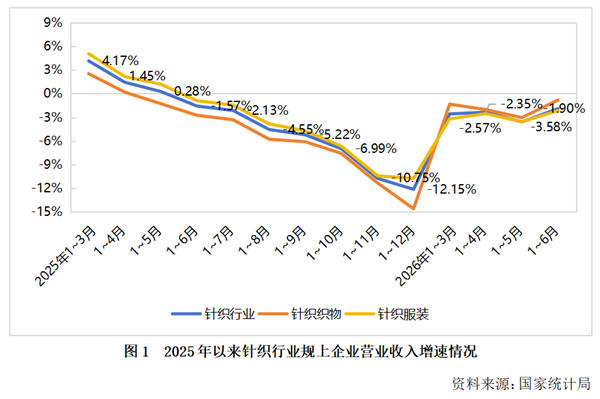
According to statistics released by the National Bureau of Statistics, operating revenue of abovedesignatedsize enterprises in the knitting industry dropped by 1.68% yearonyear in the first half of 2026, with the decline narrowing by 0.89 percentage points compared with the first quarter. By product category, operating revenue of abovedesignatedsize knitted fabric enterprises fell by 0.8% yearonyear, a decline narrowed by 0.53 percentage points from the first quarter; operating revenue of abovedesignatedsize knitted apparel enterprises decreased by 2.15% yearonyear, representing a 1.05percentagepoint narrowing versus the first quarter (Figure1). Among subsectors, knitted grey fabric and sportswear enterprises achieved favorable market performance, posting yearonyear operating revenue growth of 1.61% and 0.13% respectively. Other segments along the industrial chain faced marked pressure.
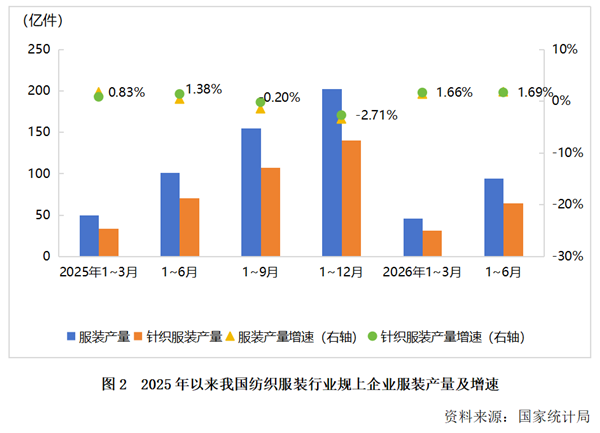
In the first half of 2026, the overall operational quality and efficiency of China’s knitting industry remained under pressure. Nevertheless in the second quarter, raw material prices retreated amid easing geopolitical tensions. Coupled with sustained recovery of domestic sales, concentrated release of seasonal orders and internal costreduction and efficiencyenhancement efforts by enterprises, the industry saw notable marginal improvement in qualityefficiency performance. Profitability recovered and the proportion of lossmaking enterprises narrowed, sending signals of phased improvement in industrial performance.
In the first half of 2026, the RMB appreciated by approximately 2.99% against the US dollar on a periodic basis, which directly eroded the USD settlement income of exportoriented enterprises. Meanwhile, the USIran conflict drove up logistics and energy costs, and domestic rawmaterial prices rose sharply. Cotton posted an average yeartodate price increase of 11.49%; polyester filament rose by 10.88%; polyester staple fiber by 9.6%; nylon filament by 5.5%; and spandex surged by 21.09%. The resonance of multiple adverse factors substantially lifted enterprises’ operating and financial costs, resulting in a steep decline in overall industrial profitability in the first halfyear.
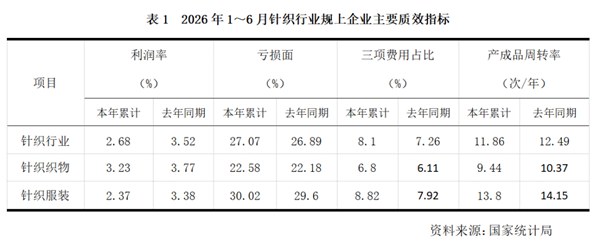
According to the National Bureau of Statistics, total profits of abovedesignatedsize enterprises in the knitting industry fell by 20.08% yearonyear from January to June 2026, 9.08 percentage points lower than the same period of the previous year. The operating profit margin stood at 2.68%, down 0.84 percentage points yearonyear. The proportion of lossmaking enterprises reached 27.07%, edging up by 0.18 percentage points yearonyear. The ratio of threeitem expenses hit 8.10%, rising by 0.84 percentage points yearonyear. The finishedgoods inventory turnover was 11.86 times per annum, a decrease of 0.63 times per annum yearonyear (Table1).
Compared with the first quarter, the second quarter showed clear recovery features: the industrial profit margin rebounded by 0.73 percentage points with markedly improved quarterly profitability; the proportion of lossmaking enterprises narrowed substantially by 5.67 percentage points. Corporate expense control delivered tangible results, and the ratio of threeitem expenses declined slightly. Only finishedgoods inventory turnover edged down, indicating a slower pace of inventory destocking.
By product category, dragged by weak endmarket demand and hampered price transmission, knitted apparel posted a steeper drop in operating profits, with its recovery of quality and efficiency lagging behind knitted fabrics.
According to statistics from the National Bureau of Statistics, from January to June 2026, total profits of abovedesignatedsize enterprises for knitted apparel and knitted fabrics declined by 27.86% and 6.61% yearonyear respectively, with profit margins standing at 2.37% and 3.23% correspondingly (Table1). Upstream fabrics demonstrated better profit stability compared with enduse finished garments. Nevertheless, profits overall remained within the lowvalue range of the industry, and the overall profitability of the sector needs further improvement.
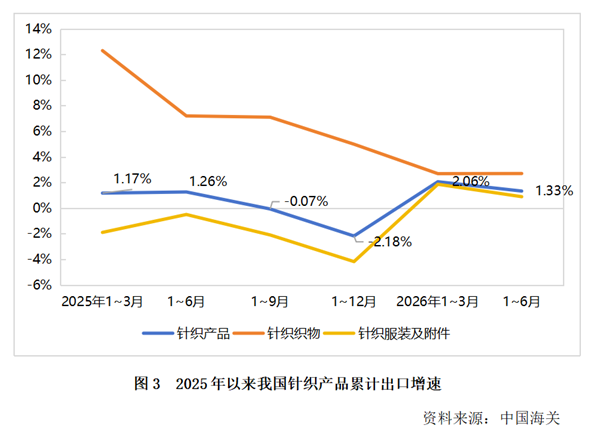
Driven by multiple factors including overseas markets’ stocking for the second halfyear, improved ChinaUS economic and trade relations, advance shipments ahead of US tariff adjustments, and partial order reshoring to China as Southeast Asian supply chains suffered energy and international logistics shocks stemming from the USIran conflict, China’s knitwear export value hit a fouryear high for the same period in the first half of 2026, sustaining a growth momentum. Against the backdrop of sluggish global market demand, escalating geopolitical conflicts and drastic shifts in tariff policies of major markets, the sector demonstrated strong resilience against headwinds.
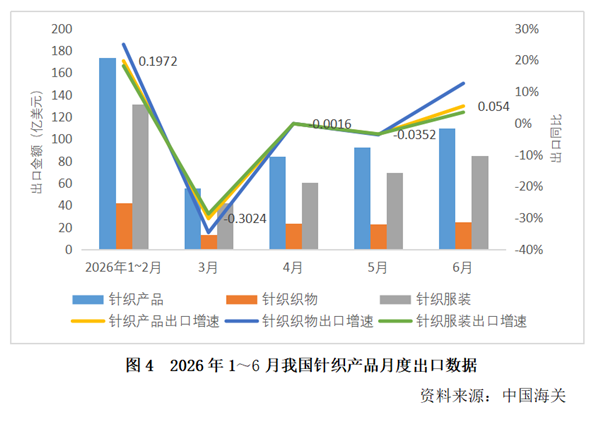
According to China Customs statistics, China’s knitwear exports reached USD51.52billion in JanuaryJune 2026, a yearonyear increase of 1.33%, up 0.08 percentage points from the same period of last year. Of this total, exports of knitted fabrics stood at USD12.685billion, rising by 2.7% yearonyear; exports of knitted apparel and accessories amounted to USD38.835billion, growing by 0.89% yearonyear, an improvement of 0.94 percentage points over the prioryear period (Figure3). By product, chemicalfiber knitted apparel posted a 2.4% yearonyear increase, while cotton knitted apparel declined by 1.5% yearonyear, reflecting notable optimization in product mix.
The sharp export surge in June mainly stemmed from concentrated shipments ahead of the implementation of new US tariffs. Meanwhile, AprilMay of last year saw a low base for China’s exports to the US amid tariff impacts, which drove strong yearonyear growth in USbound exports this year. Fundamental global market demand has not undergone material changes.
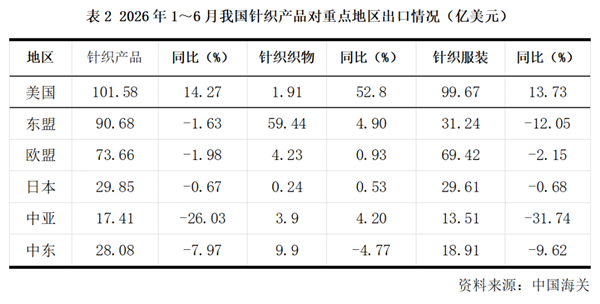
From January to June 2026, China’s knitwear exports to the United States reached USD10.158billion, rising by 14.27% yearonyear. This contributed 5.8 percentage points directly to China’s total knitwear export growth, ending a consecutive declining trend and hitting a multiyear high growth rate. Such performance was mainly driven by US tariff policies, resulting from the lowbase effect in the same period of last year plus prepolicy rush shipments ahead of the new tariff rules taking effect.
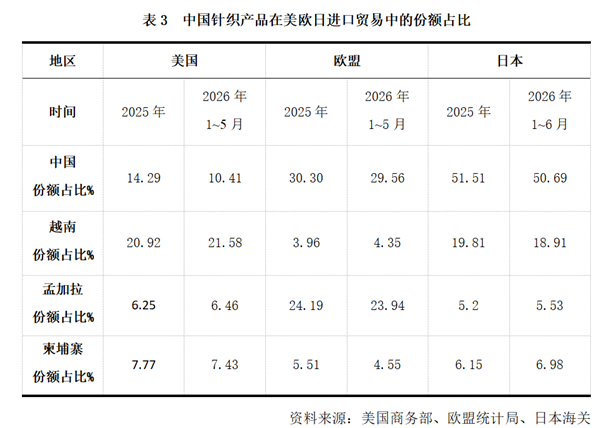
According to data from the U.S. Department of Commerce, China’s market share of knitwear in U.S. imports continued its downward trend from January to May 2026, falling from 14.29% in 2025 to 10.41%, yet edging up by 0.08 percentage points compared with the first quarter. Suffering from energy and logistics shocks, Vietnam, Bangladesh and Cambodia saw partial orders reshoring to China. Their respective market shares in the U.S. stood at 21.58%, 6.46% and 7.43%, all posting declines versus the first quarter.
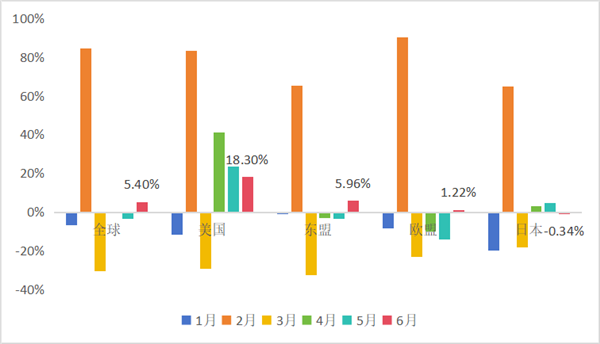
Exports to the EU reached USD7.366billion, down 1.98% yearonyear. Exports to the EU registered a 6.74% yearonyear increase in the first quarter. Since the ChinaUS tariff conflict, China’s knitwear exports to the EU had maintained continuous growth and served as a major contributor to overall export growth. Affected by the USIran conflict, soaring energy costs in the EU pushed inflation higher and weakened consumer demand, compounded by shifts in EU trade policies. From April to May, China’s knitwear exports to the EU fell by 10.04% and 13.91% yearonyear respectively (Figure5), becoming the main drag on firsthalfyear exports.
According to data from Eurostat, due to the yearonyear drops of 10.04% and 13.91% in China’s knitwear exports to the EU in April and May respectively, China’s share of knitwear in EU imports slipped to 29.56% in JanuaryMay 2026, down from 30.3% recorded in 2025. Over the same period, Bangladesh’s market share rose to 23.94%.
Exports to Japan amounted to USD2.985billion, a yearonyear decrease of 0.67%. After a shortlived rebound in 2025, exports to Japan slipped back into decline. According to Japanese Customs statistics, China’s knitwear import market share in Japan edged down slightly from 51.51% in 2025 to 50.69% in JanuaryMay 2026, yet posted a modest recovery compared with the first quarter. Amid strained ChinaJapan relations, the Japanese market is expected to maintain a downward trend.
Exports to the ten ASEAN Member States reached USD9.068billion, down 1.63% yearonyear, with the decline narrowing by 1.69 percentage points compared with the first quarter. Of this total, exports of knitted fabrics stood at USD5.944billion, rising by 4.9% yearonyear, representing an expansion of 3.26 percentage points versus Q1. Following the temporary ceasefire in the USIran conflict in June, ASEAN supply chains rebounded rapidly, driving a 5.96% yearonyear growth in China’s knitwear exports to ASEAN. In recent years, Chinese enterprises have accelerated capacity relocation to Southeast Asia, and newlybuilt production capacities have come on stream one after another, resulting in reduced reliance on Chinese supplies. Meanwhile, eased US tariff policies together with RMB appreciation have led to a drop in finishedgoods reexport trade. (Table2, Table3).
3.2 Emerging Markets Serve as Core Growth Drivers; Diversification Strategy Delivers Notable Results
In recent years, amid drastic shifts in the international landscape, China‑Russia relations have been steadily consolidated, and bilateral economic and trade cooperation has maintained high‑quality development. Affected by geopolitical sanctions, successive withdrawals of Western brands have created supply gaps, and China has become a key player filling the void in the Russian market.
From January to June 2026, China’s knitwear exports to Russia reached USD 1.316 billion, surging by 38.07 % year‑on‑year. Russia emerged as one of the fastest‑growing destinations for China’s knitwear exports in the first half‑year, climbing to the sixth‑largest trading partner for China’s knitwear sector. During the China‑Russia heads‑of‑state meeting in May 2026, proposals were put forward to upgrade both goods and services trade and further advance “Single Window” interconnectivity cooperation to facilitate bilateral trade. These initiatives will further boost the rapid growth of China’s knitwear sales in the Russian market.
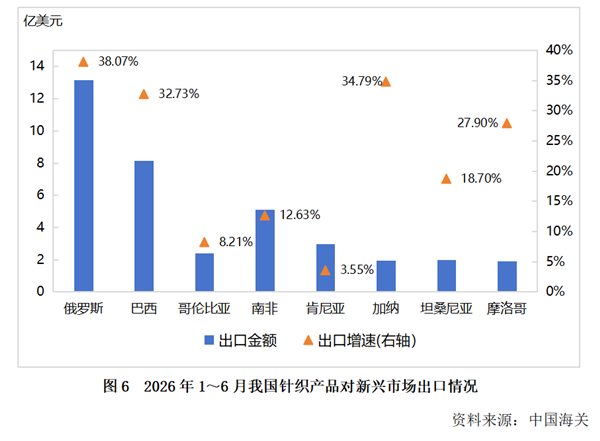
Benefiting from China’s free‑trade agreements with African countries, China’s knitwear exports to Africa have achieved rapid growth. From January to June 2026, China’s knitwear exports to Africa amounted to USD 3.80 billion, up 11.16 % year‑on‑year. Exports were mainly concentrated in South Africa, Kenya, Tanzania, Ghana and Morocco, with export values of USD 511 million, USD 297 million, USD 198 million, USD 193 million and USD 190 million respectively, representing year‑on‑year growth rates of 12.63 %, 3.55 %, 18.7 %, 34.79 % and 37.9 %. The combined exports to these five countries accounted for 36.6 % of China’s total knitwear exports to Africa. Following the full implementation of zero‑tariff policies for 53 African diplomatic partners effective May 1 this year, the African market is expected to become a key growth pole for China’s knitwear products going forward.
Meanwhile, the South American market also posted steady growth. From January to June, China’s knitwear exports to South America reached USD 2.493 billion, rising by 9.18 % year‑on‑year. Among them, exports to Brazil and Colombia stood at USD 814 million and USD 241 million, growing by 32.73 % and 8.21 % respectively compared with the prior‑year period (Figure 6). The market diversification strategy adopted by Chinese enterprises has delivered tangible results. Gradually unlocked potential in emerging markets has effectively offset demand volatility pressures stemming from geopolitical risks in traditional markets.
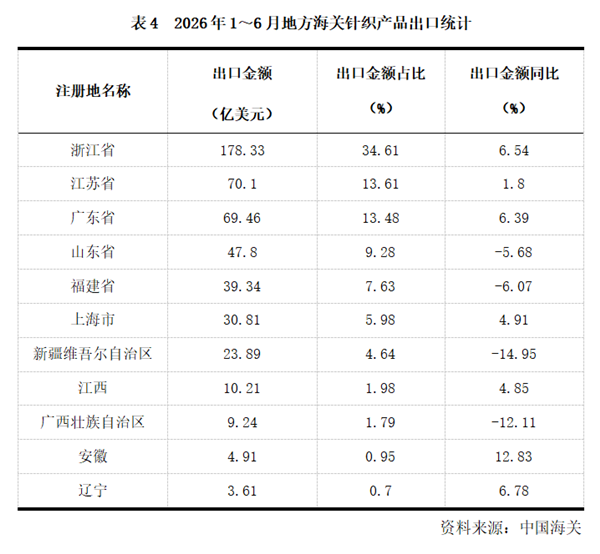
Traditional major eastern‑coastal provinces including Zhejiang, Jiangsu, Guangdong, Shandong and Fujian boast first‑mover advantages in industrial clusters, supporting supply chains, R&D and innovation, and market diversification. Their capacity to withstand external risks is markedly stronger than that of other provinces and municipalities. In January‑June 2026, combined knitwear exports from these five eastern provinces reached USD 40.503 billion, accounting for 78.61 % of China’s national total, up 1.11 percentage points year‑on‑year, with a year‑on‑year growth rate of 2.78 %, which was 1.45 percentage points above the overall export growth of the sector.
Zhejiang and Guangdong delivered outstanding performance, registering export growth rates of 6.54 % and 6.39 % respectively, outpacing the industrial average by 5.21 and 5.06 percentage points. By contrast, due to its high reliance on trade with Japan, Shandong saw its export value drop by 5.68 % year‑on‑year amid strained China‑Japan relations.
Meanwhile, several central and northeastern provinces posted export growth, reflecting further optimization of the industry’s regional structure. Henan, Anhui, Jiangxi, Heilongjiang, Jilin and Liaoning recorded year‑on‑year export growth of 17.78 %, 12.83 %, 4.91 %, 58 %, 32.81 % and 6.78 % respectively. Xinjiang and Guangxi registered year‑on‑year declines of 14.95 % and 12.11 %. Xinjiang was affected by continuously tightening EU‑US trade‑related reviews, while Guangxi suffered from sharp export slumps to Central Asia and volatile exports to Southeast Asia (Table 4).
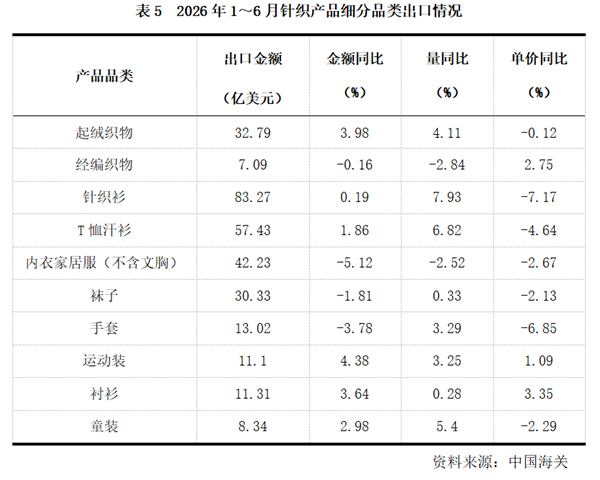
From January to June 2026, major product categories posted year‑on‑year export growth, with the exceptions of underwear & loungewear, gloves and warp‑knitted fabrics. Among them, pile fabrics, sportswear, shirts, children’s garments and T‑shirts delivered sound export performance, registering growth rates of 3.98 %, 4.38 %, 3.64 %, 2.98 % and 1.86 % respectively, outpacing the overall sector growth rate. Boosted by the World Cup, sportswear exports swung from decline to expansion, with its growth rate up 15.5 percentage points against the prior‑year period. Exports of knitted shirts reached 251 million pieces, accounting for 32.82 % of total shirt export value, rising by 1 percentage point year‑on‑year and maintaining a sustained upward trend. Hit by the dual impact of rising upstream chemical raw‑material prices and intensified market competition, glove exports saw export value and unit export price drop by 3.78 % and 6.85 % respectively. In terms of volume and value, apart from warp‑knitted fabrics, sportswear and shirts whose prices bottomed out and rebounded, most major categories continued to show a pattern of rising volume amid falling prices (Table 5).
Domestic consumption remained in a weak‑recovery range in the first half of 2026, with total retail sales of consumer goods edging up merely 1.3 % year‑on‑year and posting a month‑by‑month downward trend in the second quarter. The domestic textile and apparel market demonstrated notable resilience and acted as a stabilizer for the consumer market. According to data from the National Bureau of Statistics, retail sales of garments, footwear, hats and knitwear & textile products by above‑designated‑size enterprises rose by 6.7 % year‑on‑year, far outperforming overall consumption growth. Meanwhile, online retail sales of physical clothing goods increased by 6.2 % year‑on‑year, and online channels continued to serve as a key growth pillar.
The market saw obvious divergence across product categories. Functional, scenario‑oriented and eco‑friendly textile segments maintained high prosperity, while growth of conventional basic cotton‑based products remained moderate. Functional knitted apparel such as sports‑outdoor items, cool‑feeling sun‑protective wear, moisture‑absorbing quick‑dry garments and seamless products became core drivers of consumption growth. Demand surged for sport‑style wool garments, plus‑size knitwear and seamless maternity knit sets.
Against the backdrop of fluctuating export order mix and the shift of part of export‑oriented production capacity toward domestic sales, the domestic market has absorbed industrial capacity, fostering a complementary dual‑circulation pattern for domestic and overseas markets. The market is characterized by steady overall volume growth, divergent category performance, channel restructuring and policy‑backed support.
Entering the second half of the year, the phased stimulus effect on domestic consumption is gradually fading, and the marginal slowdown of domestic demand growth witnessed in the second quarter may persist. In July, China’s manufacturing PMI slipped to 49.2 %, falling into the contraction territory. The sub‑index for consumer‑goods manufacturing also softened, confirming that the recovery of domestic consumption will face substantial short‑term pressures before household income and consumer confidence achieve material improvement.
Nevertheless, policy support will keep intensifying in the long run. The special consumption‑boosting initiatives outlined in the 2026 Government Work Report will be implemented in synergy with the medium‑ and long‑term consumption‑promotion plan for the 15th Five‑Year Plan period. Policy dividends will continue to unfold through a series of measures including fostering domestic brands, expanding scenario‑based consumption, and launching textile and apparel trade‑in programs. Household endogenous consumption momentum will recover steadily. The domestic knitwear market will generally maintain a moderate recovery tone, with structural growth opportunities across niche segments.
The global economic and trade environment remains complex and volatile with markedly heightened uncertainties. External‑demand support for China’s knitwear exports has weakened, and multiple headwinds continue to cap upside potential for the sector’s export growth. Geopolitically, the resurgence of the US‑Iran conflict has triggered sharp swings in crude‑oil prices, chemical‑fiber raw‑material costs and logistics expenses. On the exchange‑rate front, the RMB maintains a phased appreciation trend, continuously eroding foreign‑exchange‑settlement proceeds for export‑oriented enterprises.
The central growth level of global trade has declined substantially. In its latest *World Economic Outlook* released in July, the International Monetary Fund (IMF) revised down its forecast for full‑year global economic growth to 3 %, with advanced‑economy growth projected at merely 1.7 %. As China’s core traditional export destinations for knitwear, the EU, the United States and Japan suffer from sluggish economic recovery, leaving diminishing room for export expansion in these traditional markets.
Trade‑policy barriers keep ramping up. New U.S. Section 301 tariffs have taken effect, and China is listed among economies subject to the maximum 12.5 % tariff rate. China is also facing two separate Section 301 investigations concerning so‑called intellectual‑property issues and alleged excess industrial capacity, in addition to an extra 40 % punitive tariff imposed on transshipped goods. The country‑differentiated provisions under the new U.S. Section 301 tariffs will accelerate the regionalization and fragmentation of the global apparel supply chain. Chinese enterprises’ long‑standing strategy of building overseas production facilities to bypass tariffs will confront new risks and challenges.
The EU Carbon Border Adjustment Mechanism (CBAM) has been expanded to cover the entire textile value chain. Carbon tariffs, the removal of duty‑free treatment for small‑value parcels, and the Ban on the Destruction of Discarded Textiles under the EU Sustainable Products Ecodesign Regulation (ESPR) have formally entered into force, banning large enterprises from destroying unsold textile products. Meanwhile, textile‑specific Extended Producer Responsibility (EPR) rules and Digital Product Passport (DPP) requirements are being rolled out. The Anti‑Greenwashing Directive (EMPCO), trade‑remedy measures and tariff policies will also come into force successively. Such overlapping regulatory thresholds drive up overall export costs. Domestic demand in Japan keeps shrinking amid strained China‑Japan relations, and Japan’s import share of Chinese knitwear has been sliding year‑on‑year.
Meanwhile, structural opportunities coexist within the industry. Leveraging three core competitive strengths — China’s complete and well‑established whole‑industrial‑chain supporting system, stable energy supply guarantee and super‑large‑scale domestic demand market — China’s knitwear sector has demonstrated growing risk‑resilience when compared with Southeast Asian countries, which are plagued by energy shortages and obvious shortcomings in supply‑chain supporting facilities. Knitwear exports will maintain fundamental resilience in the second half‑year. Emerging markets along the Belt and Road Initiative will serve as a key growth pillar to offset downward pressures from advanced economies.
Faced with multiple challenges as well as structural development opportunities in domestic and overseas markets, the whole industry is formulating systematic response strategies centering on the high‑quality development theme of the 15th Five‑Year Plan period. It is critical to seize the window of phased tariff easing to consolidate the base of exports to the United States. Financial and procurement instruments such as forward foreign‑exchange hedging and long‑term raw‑material price‑locking agreements shall be flexibly adopted to hedge against two‑way volatility risks of exchange rates and raw‑material prices and underpin corporate profitability.
The industry shall further deepen global market diversification, conduct regular risk assessments on geopolitics and trade policies, and continuously reduce reliance on individual advanced markets. It is essential to further tap high‑potential emerging markets including Russia, Africa and Latin America. Greater efforts shall be devoted to scientific and technological innovation to accelerate product supply upgrading, advancing the industry’s transformation toward functionalization, green low‑carbon development, intelligence and high‑end positioning. Supported by AI‑driven digital transformation, flexible production and lean management can be implemented to break the long‑standing predicament of low‑price cut‑throat competition characterized by rising volume alongside falling prices.
Meanwhile, the industry should further unlock the potential of the domestic market, capitalize on dividends brought by national consumption‑boosting policies, accelerate the cultivation of home‑grown brands, expand access to lower‑tier markets and specialized niche consumer segments. It will promote coordinated interaction between domestic and overseas markets, foster new drivers for industrial development, and steadily achieve steady improvement and sustainable high‑quality development for the knitwear sector during the 15th Five‑Year Plan period.
Source: China Knitting Industry Association URL: [https://www.cntac.org.cn/zixun/shuju/202608/t20260817_4418680.html]
- Pre:The Expanded Meeting of the In 2026/9/4
- Next:Successful Conclusion,Wuhan He 2026/8/28